
One Vehicle, One Story: the Volkswagen Golf GTI MK1, a youngtimer icon for an entire generation
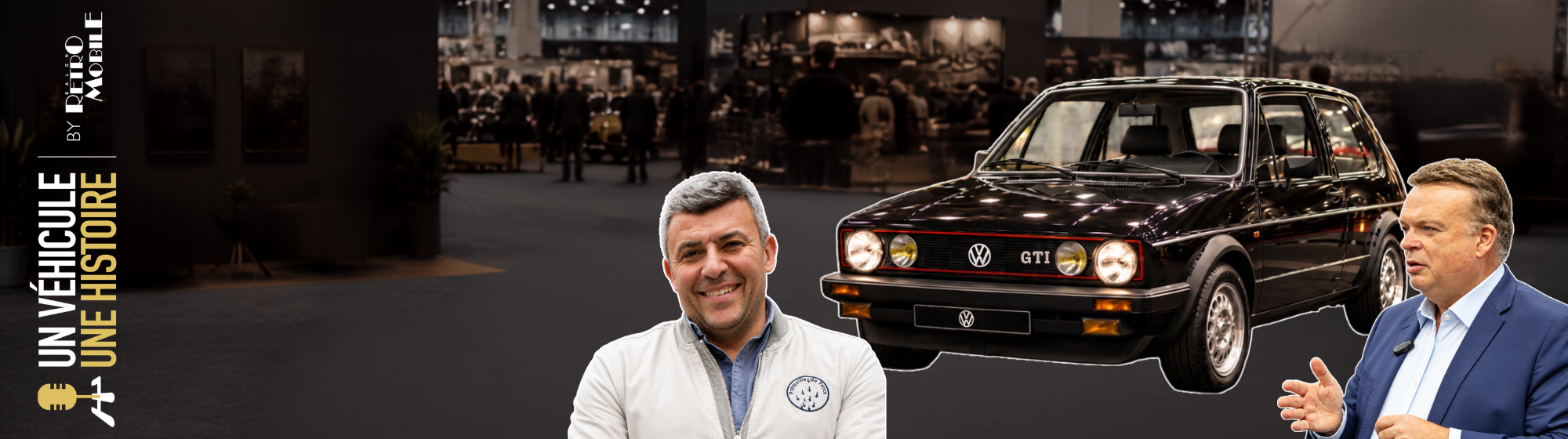
Golf GTI MK1: the car everyone wanted
Some cars don't just belong to their owners. They belong to an entire generation. The first-generation Volkswagen Golf GTI is one of them. In the 1970s and 80s, it was everywhere: in children's dreams, in enthusiasts' conversations, in posters pinned to bedroom walls. "It's the car everyone wanted. We all wanted our parents to buy one," confesses François Bacquet.
Fifty years after its debut at the Frankfurt Motor Show in 1975, the Golf GTI MK1 has become one of the most sought-after youngtimers on the collector market. Values are climbing, original examples are growing scarcer, and the enthusiasm shows no sign of fading. That is the nature of true icons: they cross the decades without really ageing, carried forward by the nostalgia of those who once dreamed of them and the curiosity of those discovering them for the first time.
Golf GTI: the birth of a concept
To understand what the Golf GTI represents, you have to put its birth in context. In 1974, Volkswagen launched the Golf, a front-wheel-drive hatchback intended to succeed the legendary Beetle. A revolution for the brand. But in the corridors of Wolfsburg, a handful of engineers and enthusiasts, led by Ernst Fiala and Anton Konrad, were working alongside the official project on a more powerful, sporting version built with drivers in mind.
Volkswagen, sceptical, planned to build just 5,000 of them. More than 450,000 Golf GTI MK1s would ultimately roll off the production line between 1976 and 1983. An entirely unforeseen success, one that invented a whole new segment and redefined for decades what an accessible sports car could be.
The concept is simple, radical, and quietly brilliant: take the standard Golf body, fit a 1.6-litre Bosch fuel-injected engine producing 110 horsepower, and leave almost everything else alone. No aggressive spoiler, no garish body stripe. Just a red band on the grille, discreet side pinstripes, and a leather-rimmed three-spoke steering wheel. Enthusiasts spotted the details. Everyone else just saw a Golf.
Golf GTI MK1: an original car, found by chance
François Bacquet's story with his Golf GTI begins in 2001, with a stroke of luck that resembles every great automotive love story. He isn't actively looking, that can wait, there's no rush. And then, at a dealer in Fontainebleau, there it is. "I found it, and it was instant." Two seconds to decide. A lifetime of no regrets.
What draws him in immediately is its history: first owner, original registration, unmodified, delivered exactly as it left the dealership. The first owner kept it for twenty years. François Bacquet is the second, and by 2026, he has been its longest custodian by some distance. "You're already the longest owner in its history," notes François Allain.
The car carries one small detail that says a great deal about the era: delivered from the factory on steel wheels (there were almost no options on these early GTIs, no electric windows, no central locking), the first owner had aluminium alloys fitted at the dealership, as many buyers did at the time. Everything else is entirely original.
Golf GTI MK1: 25 years of pleasure, very little expenditure
Over a quarter of a century, François Bacquet's Golf GTI has caused no major trouble. A repaint around ten years ago, when the original finish was beginning to dull. And beyond that, nothing. "She runs well," he says simply.
The secret to her good health comes down to one rule François Bacquet applies consistently: keep driving her. Around 5,000 kilometres a year, enough to keep the mechanicals alive without wearing out what needs to be preserved. And if the car sits idle too long between outings, he takes her out for at least 20 kilometres. "The Germans say: 20 kilometres, every 20 days, for at least 20 minutes." A golden rule that seasoned collectors know well, and one François Allain notes immediately: cars that don't move deteriorate. Always.
On the road, the Golf GTI MK1 remains a genuine pleasure to drive, and it doesn't go unnoticed. "It gets thumbs up from people, even more so now than a few years ago," says François Bacquet. Age has only added to its charm.
Golf GTI MK1: the informed buyer's guide
When someone has owned the same car for 25 years, the question is inevitable: what would you tell someone looking to buy one today? François Bacquet has clear answers, built from experience.
First principle, and the most important: quality over price. "Even if it costs a little more, a beautiful car at €20,000 is worth more than an average one at €12,000." Advice that applies to all classic cars, but particularly crucial for the Golf GTI MK1, where genuinely sound, original examples are becoming increasingly rare.
On engines, two units were fitted across production: the 1,600cc unit producing 110 horsepower, fitted until 1982, and the 1,800cc which followed, slightly torquier without being significantly more powerful. "It's more enjoyable," says François Bacquet without hesitation. The arrival of the five-speed gearbox in 1980 is another factor worth considering.
On phases, the distinction matters for the market. Phase 1 cars (small lights, small bumpers, the famous round-dial instrument cluster) are more sought-after and more expensive, produced in smaller numbers because Volkswagen had not anticipated the GTI's commercial success. Phase 2 cars are equally attractive and represent a sensible entry point into the collection at a lower price.
On tuned versions (Oettinger in particular), François Bacquet is straightforward: the premium is real, but the driving experience is not dramatically different. "At half the price, I'd rather have a 1800 than an Oettinger." For those chasing the ultimate collector's grail, those versions exist. For those who want to drive and enjoy, the standard GTI is more than enough.
Golf GTI: the Golf 2 alternative, the smart compromise
Asked about an alternative for a younger collector on a tighter budget, François Bacquet points without hesitation to the second-generation Golf GTI. "It's a good compromise. A little more refined, a little quieter, a little roomier." The vintage feel is there, only slightly less pronounced than on the MK1, with 112 horsepower that are more than sufficient for enjoying the road. And prices are notably more accessible, making it a natural entry point into the GTI world for first-time collectors.
The Golf 3 marks a shift towards greater comfort and equipment, a different direction that suits a different type of collection. But for those seeking the essence of what the Golf GTI stood for in the 1980s, the first two generations remain the undisputed references.
Golf GTI at Rétromobile: a star in its element
At Rétromobile 2026, François Bacquet's Golf GTI MK1 held court on the Volkswagen stand, drawing the same kind of quiet, knowing attention that has always defined the GTI. No need to overstate anything. No spoiler, no garish colour, no lengthy explanatory panel. The car speaks for itself, to those who know it by heart and to those encountering it for the first time.
"I'm a happy collector," says François Bacquet. After 25 years with the same car, original, in excellent health, exhibited at France's most iconic classic car show: it's hard to argue with that.